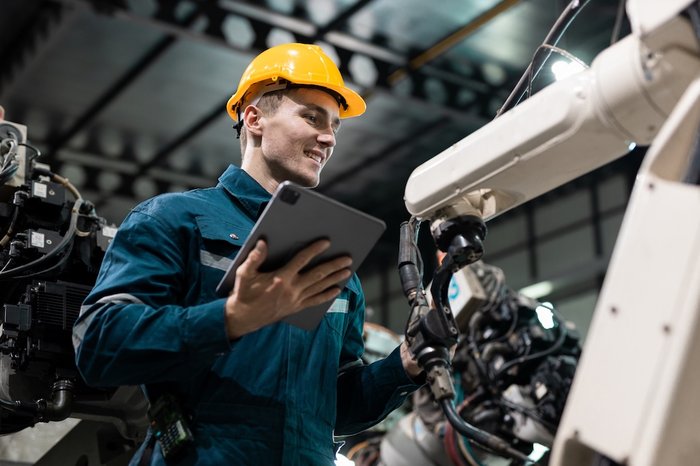
Upskilling and reskilling prepare the light industrial workforce for tomorrow. Employees can take on higher-level roles and responsibilities to add more organizational value. Upskilling involves developing an employee’s skill set to improve job performance. In contrast, reskilling involves developing skills to take on a new role.
Industry 4.0 is increasing the use of new technologies, automation, and digitization in light industrial firms. As a result, the demand for digitally skilled employees is growing.
Benefits of Light Industrial Upskilling and Reskilling
Upskilling and reskilling provide these benefits for light industrial employees:
- Expanded career opportunities
- Elevated professional growth opportunities
- Enhanced professional relationships
- Increased motivation
- Improved performance
- Higher engagement
- Greater collaboration
- Stronger problem-solving
- Elevated productivity
- Increased job satisfaction
- Higher morale
- Elevated loyalty
- Stronger attraction and retention rates
- Increased workforce resilience
Upskilling and reskilling provide these benefits for light industrial employers:
- Adapting to changing business needs
- Filling skills gaps
- Increasing workforce flexibility
- Saving time and money on hiring and onboarding
- Providing long-term solutions for future developments
- Maximizing organizational efficiency
- Optimizing business operations
- Attaining company goals
- Driving revenue
- Strengthening the bottom line
- Achieving strategic initiatives
- Expanding business growth
- Navigating uncertainty
Upskilling and reskilling help light industrial firms optimize operational efficiency, meet customer demand, and maintain a competitive edge. The following strategies can help.
Prioritize Employee Development
Customize learning and development opportunities according to light industrial roles, business goals, and strategic initiatives. Aligning learning with long-term objectives helps employees develop relevant knowledge and skills to adapt to changing business needs. Maintaining workforce resilience while navigating the unknown strengthens long-term growth.
Leverage Data
Collecting and analyzing data on production processes, machine performance, and other key metrics helps identify areas for improvement. Then, light industrial employers can develop targeted training programs to address specific skill gaps.
For instance, analyzing data on machine performance helps identify opportunities for additional training to elevate efficiency and reduce downtime. Data also can be used to track employee performance and identify individuals who could benefit from additional training and support.
Artificial intelligence (AI)-powered learning and development tools can review a light industrial employee’s experience to determine how their skills gaps align with their career goals and the company’s strategic plans. Then, the tools can develop hyper-personalized learning journeys to support upskilling and reskilling for continuous success. A similar approach can be used for groups of employees whose jobs will change due to business needs.
Offer Online Training
Online training offers convenience for learning and development. Light industrial employees can access the training from anywhere with an internet connection.
Live webinars, virtual classrooms, online self-paced courses, on-demand learning, and virtual reality (VR) simulations can be used to train light industrial employees. Quizzes, tests, VR scenarios, and hands-on projects can evaluate understanding and retention.
Implement Virtual and Augmented Reality
Virtual reality (VR) and augmented reality (AR) deliver immersive training experiences for light industrial employees. The technologies provide simulated work processes to help employees practice their skills in realistic, engaging training environments. These activities safely prepare employees for real-world experiences.
VR and AR training can be more cost-effective than other training methods:
- VR and AR training can be scaled to include teams of all sizes.
- Light industrial employers can reduce the cost of materials and equipment associated with in-person training.
- Employees receive instant guidance and constructive feedback.
- Light industrial employees quickly learn from their mistakes to improve performance.
- Employees can repeat the training as needed to improve their skills.
- Strengthening employee confidence in performing complex tasks reduces real-world accidents and injuries.
Use Gamification
Increasing engagement in learning motivates light industrial upskilling and reskilling. As a result, many employers include gamification in their training programs.
Gamification can simulate real-world scenarios and provide hands-on training in a safe, controlled environment. This approach is especially effective in teaching complex procedures or machinery operations. Employees can practice new skills and receive constructive feedback without damaging equipment or endangering themselves or others.
Challenges, points, leaderboards, badges, rewards, and other game-like elements strengthen employee learning and retention. The results include greater productivity and job performance.
Encourage Continuous Learning
Develop a culture of ongoing learning and development within the light industrial workforce. Provide resources and support to encourage lifelong learning.
Regular training sessions, workshops, and access to e-learning platforms foster a growth mindset. Employees can stay current on industry news, trends, and best practices as they enhance their skill sets.
Steps to Upskill a Light Industrial Workforce
These guidelines help upskill a light industrial workforce:
- Assess current skills: Map each employee’s skills to create a baseline for measuring progress.
- Identify future skills: Determine which skills align with long-term business goals.
- Develop upskilling goals: Create employee-specific goals that align with company goals.
- Match employees with learning opportunities: Customize learning and development opportunities according to employee goals.
- Monitor progress: Digitally track employee training and job performance to evaluate proficiency, uncover gaps, and develop upskilling opportunities.
Steps to Reskill a Light Industrial Workforce
These guidelines help upskill a light industrial workforce:
- Identify skill cultivation: Clarify valuable skills for new roles and create training programs to develop them.
- Implement upskilling: Begin providing training programs for skill development in alignment with strategic plans.
- Tailor employee learning plans: Plan core learning opportunities for current and future roles.
- Test and adjust: Modify learning plans according to employee progress and business needs.
- Develop an upskilling budget: Allocate money to prioritize employee upskilling.
Partner with a Light Industrial Staffing Agency
A light industrial staffing agency can help develop training programs for employers to upskill and reskill their workforce. Company leaders can collaborate with recruiters to develop customized skill-development programs aligned with company needs to support business growth.