Your line doesn't stop bleeding because you hired more people.
It stops when you hire the right ones.
Every staffing company says they do food and beverage. Then they send you someone who doesn't know the difference between a sanitation crew and a cleaning crew. We've managed over $138 million in food and beverage production staffing. We know your floor because we've been on it.
Talk to someone who knows your operation
You don't have a hiring problem. You have a throughput problem.
When you call a staffing company, most hear “I need 12 more people” and start filling seats. We hear it differently, we ask where the throughput is leaking, what tier of labor is missing, and what your changeover schedule looks like this month.
Because when you call a staffing company, you’re not thinking about headcount. You’re thinking about the line, the 14% throughput gap between lines 2 and 4 on second shift, and you already know the root cause:
Mix of skills gap
Absenteeism
Supervisors stretched thin
We Know Your Floor
We don't staff "manufacturing." We staff your specific operation.
Food and beverage production isn't one thing. A baked goods line runs differently than a bottling line. A protein plant has different failure modes than a meal kit facility. The staffing company that treats them the same will cost you more than the one that charges more.
Here's what we know about yours.
Food Production
Your three biggest enemies aren't competition, material cost, or regulation. They're moisture, time, and inconsistency. Every person on your line is either holding process fidelity or breaking it. We know the difference between your line labor, the packers and palletizers who need stamina and rhythm, and your skilled operators who understand that running a mixer 45 seconds too long means downstream rejection. We know sanitation isn't janitorial work. It's a technical discipline with ATP verification, allergen protocols, and regulatory stakes.

Your throughput leaks: Changeover delays from untrained crews. Unplanned downtime because an operator missed early warning signs. Quality holds from spec deviation. Absenteeism cascades that shut down a line, not just a station. Sanitation overruns because the last agency treated CIP like mopping.

Your calendar: Holiday surge hits October through December. Demand spikes 40 to 60 percent in baked goods. Harvest-driven canning waits for no one. If we're having the staffing conversation in November, we're already too late.
Beverage Production
Your world is measured in bottles per minute. Everything in your plant is designed around velocity, and speed amplifies everything. Including mistakes. When your filler runs at 400 BPM and an undertrained operator takes two extra minutes to respond to a fault, that's 800 bottles of potential waste. At 800 BPM, it's 1,600. The math is unforgiving, and it's why you can't afford to treat your operation like a warehouse with a different label on the door. We understand the machine-human interface that drives beverage production. Your best operators don't just push buttons. They listen to the line. That intuition takes months to build. We don't pretend we can replace it with a temp. What we can do is backfill your lower-complexity roles so your experienced people stay where they matter most.

Your throughput leaks: Filler stoppages from slow operator response. Changeover time creep from high SKU turnover. Cap and seal rejects from undertrained quality checks. Palletizing errors that become chargebacks at the DC.

Your calendar: Demand for water and energy drinks surges in the summer. But inventory builds start in March, so the staffing conversation needs to happen in January. If someone's calling you in May, they don't understand your business.
Prepared Foods and Meal Kit
Your product has a shelf life measured in days, not months. That single fact changes the math on every staffing failure. In traditional food manufacturing, a bad production day can sometimes be absorbed. You have a shelf life buffer. In your operation, a bad day means a customer doesn't get their box. There's no buffer. There's no inventory to pull from. And when you miss a production window, that inventory doesn't become rework. It becomes waste. Portioning looks simple from the outside. It's one of the hardest things to staff well. Speed, precision, allergen separation, accurate weights, temperature control, visual quality standards. All at the same time, all shift long. We screen for food handling aptitude, not just willingness.
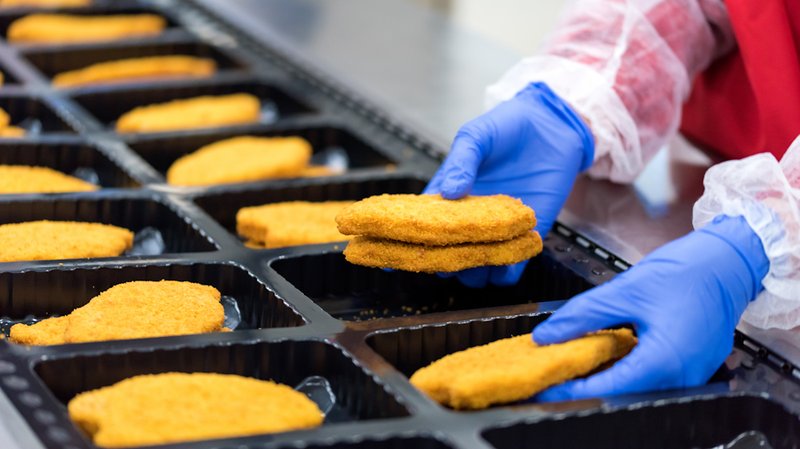
Your throughput leaks: Portioning variance that compounds into six-figure yield loss over a production cycle. Assembly errors that generate customer complaints. Cold chain breaks due to workers who don't feel the urgency around temperature. Menu transition waste because high turnover means you're perpetually retraining.

Your calendar: Demand peaks in January and early fall. Counterintuitive until you understand the subscription model. But the biggest spikes aren't seasonal. They're operational. New distribution hubs, new product lines, retail partnerships that need 50 trained people yesterday.
The Cost of Getting It Wrong
The math your current staffing partner isn't showing you.
Food and beverage plants lose an average of 25 hours per month to unplanned downtime. At average industry costs, that's over half a million dollars a month in lost production per facility. Personnel-related factors drive at least 32% of those events.
But the bigger number is the one that doesn't show up on a downtime report.
The Turnover Tax
Food processing leads all manufacturing sub-sectors at 36% annual turnover. For a 200-person plant, that's 60 departures a year. At $6,000 per replacement, and that's conservative, you're bleeding $360,000 in direct costs before you count the productivity loss during vacancy and ramp. Total annual damage: north of $500,000.
The Placement Ratio
For every dollar of staffing margin on an hourly worker, a bad placement can cost you $60 to $225 in throughput damage. One undertrained operator at a mid-speed beverage filler can create $5,000 to $18,000 in product risk per shift. Across a week, that's $25,000 to $90,000 from a single wrong placement.
The Safety Stakes
The average food recall costs $10 million in direct expenses. In 23% of cases, it exceeds $30 million. Fifty-six percent of recalls trace back to operational mistakes. Every person a staffing company places in your facility is a node in your food safety system.
These aren't hypotheticals. They're industry-verified numbers. And they're why plant managers get furious about quality of placement. Not because they're difficult. Because the cost of getting it wrong is real and immediate.
We're Not New To Your Floor
$138M+ in food and beverage production staffing managed
12,000+ Teammates deployed across food and beverage facilities
150+ food and protein producers served
20 accounts exceeding $1M in annual managed spend
Talk to someone who knows your operation
The Levers That Actually Move Your Numbers
GMP-Ready Before Day One. Every Teammate arrives with foundational food safety training, allergen awareness, and PPE knowledge. Your orientation reinforces site-specific protocols. Ours covers the baseline so you're not starting from zero.
Physical Capability, Honestly Matched If the role is 10 hours standing in a 38-degree room portioning chicken, we tell them that before they accept. If it's 50-pound cases for an entire shift, they know. Honest matching prevents the single biggest source of early attrition: people placed in roles their bodies can't sustain.
Attendance Infrastructure, Not Attendance Hopes
We don't treat no-shows as an inevitability. We over-dispatch. We maintain backup pools. We call people the night before. We track patterns and remove chronic offenders. Your no-show rate has a throughput multiplier. When three of ten don't show on Monday, you don't lose three positions. You lose the line.
Seasonal Ramp Planning, Not Seasonal Panic.
We study your production calendar. We know when your demand hits. We propose staffing ramp plans before you need to ask. If your holiday surge starts in October, our recruiting pipeline started building in August. We believe a partner shows up with a plan, while a vendor waits to be told.
Tier-Matched Placement
We don't send a warehouse worker to a retort station and call it "manufacturing experience." We segment our candidate pools by capability type and industry exposure. Line labor gets screened for stamina and coachability. Skilled operators get vetted for process understanding. Sanitation crews get trained as the technical role it actually is.
Data That Proves It
We track which placements convert to full-time. We measure average tenure against your previous partner's. We correlate our no-show rates with your OEE on those shifts. When we bring you data, we're telling you we're invested in outcomes, not invoices.

Meet The Person Who Owns Your Outcomes
Lily Hardwick Director, Food and Beverage Solutions
Lily doesn't manage your account from a desk. She understands what happens when a sanitation crew isn't ready for a CIP cycle, why your Tuesday absenteeism rate is different from your Friday rate, and what a 40% holiday surge means for your training ramp timeline.
When she walks into your facility, she's not learning your business for the first time. She's confirming what she already knows about your throughput pressure and identifying where your current staffing model is creating drag.
Her job isn't to sell you a service. It's to make sure every person we place on your floor protects your output, your compliance, and your operation's reputation.
Schedule a conversation with Lily
Built To Last. Owned By The People Who Run It
-

Ōnin is employee-owned. We're not backed by private equity. We don't answer to shareholders who've never been inside a plant. The people who make decisions about your workforce are the same people whose livelihoods depend on getting it right. That structure means we think in years, not quarters. We invest in training infrastructure, retention systems, and staffing technology because our people's futures depend on your operation succeeding. Not because a board told us to.
Jim Weaver
CEO, The Ōnin Group
-
Ōnin is employee-owned. We're not backed by private equity. We don't answer to shareholders who've never been inside a plant. The people who make decisions about your workforce are the same people whose livelihoods depend on getting it right. That structure means we think in years, not quarters. We invest in training infrastructure, retention systems, and staffing technology because our people's futures depend on your operation succeeding. Not because a board told us to.
Jim Weaver
CEO, The Ōnin Group
Your Throughput Is Bleeding. Let's Find Out Where.
Our workforce strategy team will dig into your operation, your throughput leaks, your seasonal pressure, your turnover patterns, and show you exactly where better staffing decisions recover real dollars.
No pitch deck. A conversation with someone who knows your floor.
Schedule a workforce strategy conversation
Not Ready to Talk?
Read “The Hidden Costs That Drain Your Margins” and see the retention system we've built across hundreds of food, beverage, and protein operations.